


Last week I talked about how Wearable Technology has a few gaps to address in how it assesses our health.
After doing more research, I realized the rabbit hole goes deeper.
Much deeper.
Not only is there a race to get data from your watch, wrist, ring, or band to doctors faster — there’s also a question from doctors about whether more data is good for us from a psychological perspective.
Dr. Rachael Bedard sat down with David Wallace-Wells to analyze this question in a podcast-style interview.
At the beginning of the conversation, the question from Peter Attia’s podcast was asked:
“How far are we from technology and machine learning that can tell us, twenty years down the road, whether or not we might have a neurological disease, and potentially reverse it?”
At first listen, this sounds promising.
Why wouldn’t someone want to know if they have the potential to contract a disease or metabolic disorder far in advance?
The science behind it might surprise you. Dr. Bedard cited a “cautionary tale” in South Korea, where they implemented universal screening for thyroid cancer in Korean citizens.
What scientists found in these screenings was a 15x increase in cancer findings, but despite these findings, it had no impact on the mortality rate of South Koreans.
In other words, small, clinically insignificant cancers that were found were not “killing” the population any faster. These cancers did not need treatment, and one might argue they didn’t even need a diagnosis.
Newsletter Summary:
How too much data could hurt us, and when to tune out
What data actually matters and how to quantify it
A lesson in avoiding overthinking

Keeping a “Watch”ful eye on your health
There is certainly a benefit to knowing some things about your health because of the widespread knowledge we have now about health.
A lower resting heart rate — a measurement most smartwatches and wearables will give you today — is almost always a sign of good cardiovascular health
More movement and calories burned throughout the day will likely speed up your metabolism and keep you lean
A more regulated body temperature means your immune system is functioning as it should, and your body is not actively fighting any sort of illness
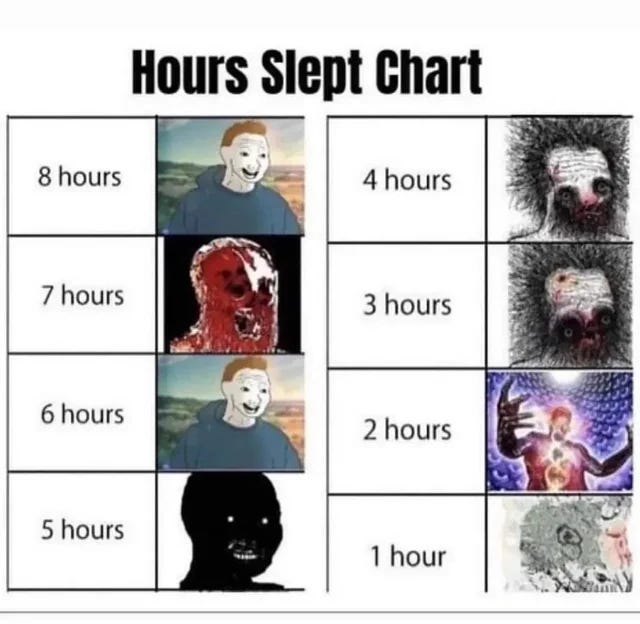
But what about the other metrics modern tech provides? Sleep scores and sleep choronotypes are not commonly understood metrics because they don’t explain how someone can feel great one day on six hours of sleep, but terrible from seven the next (see the highly agreed-upon meme below).
Many people who don’t train or track it daily can’t reasonably deduce what their HRV calculations (or fluctuations in them) mean, so being told they’re “under recovered” could lead them to falsely believe they’re not living a productively healthy life.
The truth is that our subjective feelings on a given day about how we feel might actually matter more than what the data tells us.
A few days of elevated resting heart rate is not going to kill us. Going for that long run on five and a half hours of sleep might feel absolutely euphoric.
That 7pm strength training session might feel amazing, even if your watch says you’re “stressed” and “sleep may be affected” afterwards.
I’m not saying you can’t take rest days.
There are meaningful signals — prolonged soreness/fatigue, trouble focusing, ravenous appetite — that you can deduce from to decide when it’s time to ease back.
But that’s what we as an aspiringly health-inclined society need to get back to: listening to our bodies instead of the scores these little machines give us.
And I would wager that more and more, the inclination to want to train despite being feeling a bit “off” is the one we should listen to, not the blanket advice from optimization tools.
While I hesitate to use scientific studies to prove my point, mainly because I know opposing studies that point to evidence in the other direction likely exist, there’s one study I don’t think we should overlook.
A large cohort study of almost 300,000 participants looked at the effects of sleep, physical activity, and mortality back in 2022.
In it, researchers found that short sleep was not necessarily correlated with higher mortality (sorry, Oura Ring, you’re not guilt tripping me today!).
It was, however, associated with higher mortality in the least active participants group.
In other words, the study might suggest that choosing to take an off day because you’re tired might not necessarily pay off in the long run for you.
In the physically active participants, exercise actually seemed to reduce the mortality associations with bad sleep.
This group’s mortality findings were essentially indifferent from the well-slept, active group.
Now, we can’t exactly use this as a license to skip sleep hours, either. Recovery should still be a priority at the forefront of our health journey, just not one we need to obsess over like the current culture has taught us to.
But creating conditions where exercise is habitual and becomes ingrained in your routine should ultimately trump feelings of fatigue (and even current wearable recommendations to ease up), because it very well could help you live longer.
The data that DOES matter
I want to clarify that I don’t think all data is misleading or not useful.
There are a few big rocks I think should take precedent above the storm of other numbers that are being thrown at us now with all this new technology.
We have an obligation to at least keep quarterly tabs on some of these data points not just for our own health, but for the people around us, especially us with families who rely on us.
