


I’ve thought long and hard about whether or not AI has a place in the world of health and fitness.
My (maybe underwhelming) conclusion is that it should be a relatively limited one. It’s not perfect at creating comprehensive workout plans — which I’ll delve into later in this piece — or at getting super specific and granular unless you tell it to.
And at that point, I’d argue whether or not you’re wasting time. Why?
Because the specificity and results you could derive from working with a human could be attained, at least for now, far more easily than prompting a chatbot to death about the exact weights, reps, sets, and cardio splits you want in your 3-day-a-week plan.
In trying to keep up with the latest and greatest in the world of AI, I started demoing ChatGPT Health, which is now available to U.S. ChatGPT users, both free and paid.
Paid users, as you might expect, will enjoy a bit more processing power and more comprehensive answers, and I won’t be subscribing anytime soon (unless a few free subscribers consider upgrading their HPH subscriptions to help fund my research project!), but I don’t think there’s much more to the paid version than the free.
Anyway, let’s have at it. I’ll give you the rundown in case you care to toy around if you haven’t already.
My ChatGPT Health Review
ChatGPT Health pairs nicely with Apple Health, so all iPhone users can almost immediately enjoy a dashboard of a few metrics that sync with OpenAI’s platform.
Steps, kcals burned, flights climbed, synced workouts from certain wearable devices, and some sleep metrics all populate in Chat’s initial readout, but it’s nothing you don’t already have on your phone.


The prompts it offers work as good starting points for people who are confused about their health, but here’s where that becomes an issue.
With all the data we have available to us now, is anyone really that confused about their health?
The “take action today” prompt is the silliest to me, because I’d like to believe most people who need to improve some aspect of their health already know what it is without asking Chat.
Still, I asked it that question anyway just to see what it would spit out:
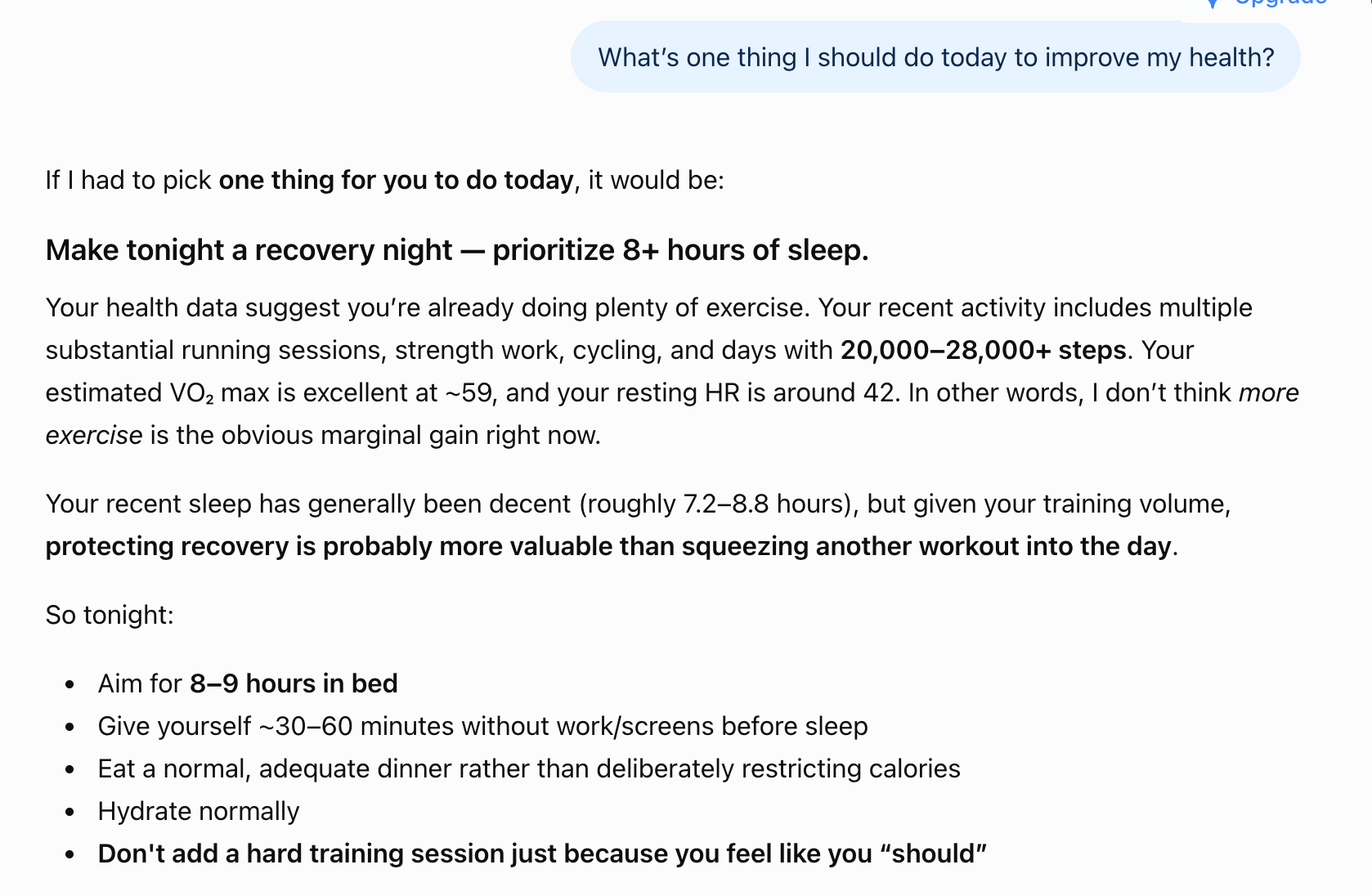
Again, nothing I didn’t already know.
Would I disagree with this recommendation? Not really.
But with the NYC Marathon looming, I actually am thinking about incorporating harder training very soon. I think that’s where these Health AIs will eventually hit a wall.
Lots of Type A people are also very Type A about their health. That means they’ll want to push even on days when Chat, their doctor, and even their loved ones will tell them not to.
Redundancies aside, it’s a step in the right direction for health knowledge, because it might allow a pretty well-thought-out second opinion for blood work faster than booking a second doctor’s appointment at an office that’ll take who-knows-how-long to book you in.
But here is a more fleshed-out list of the pros and cons I think you should consider before completely outsourcing your health thinking to the platform (Please, don’t actually do that).
Pros of ChatGPT Health

Pairs with a fairly large (but not complete) list of health systems to link lab results — I was able to connect Mount Sinai health data from past physicals to the platform, which gave it some preliminary data to work with. The more data from your lab results it has to work with, the better I anticipate its recommendations will be. However, this hinges on something that is a HUGE con for me, which I’ll bring up later.
Does well to ease nerves about lab results being out of range — Whereas the pre-AI Google flow was usually Search Query > “What does (insert lab reading here) mean?” > WebMD or Cleveland Clinic article about how you might die of some ailment; ChatGPT Health actually does well to offer actionable suggestions about how you can manage the blood test results that are out of range. It can be scary to see something not clicking, especially if you’re as neurotic as I am, and one can spiral if they feel healthy, but the labs say otherwise. I actually got some pretty nice feedback when I expressed some concern about kidney readings:
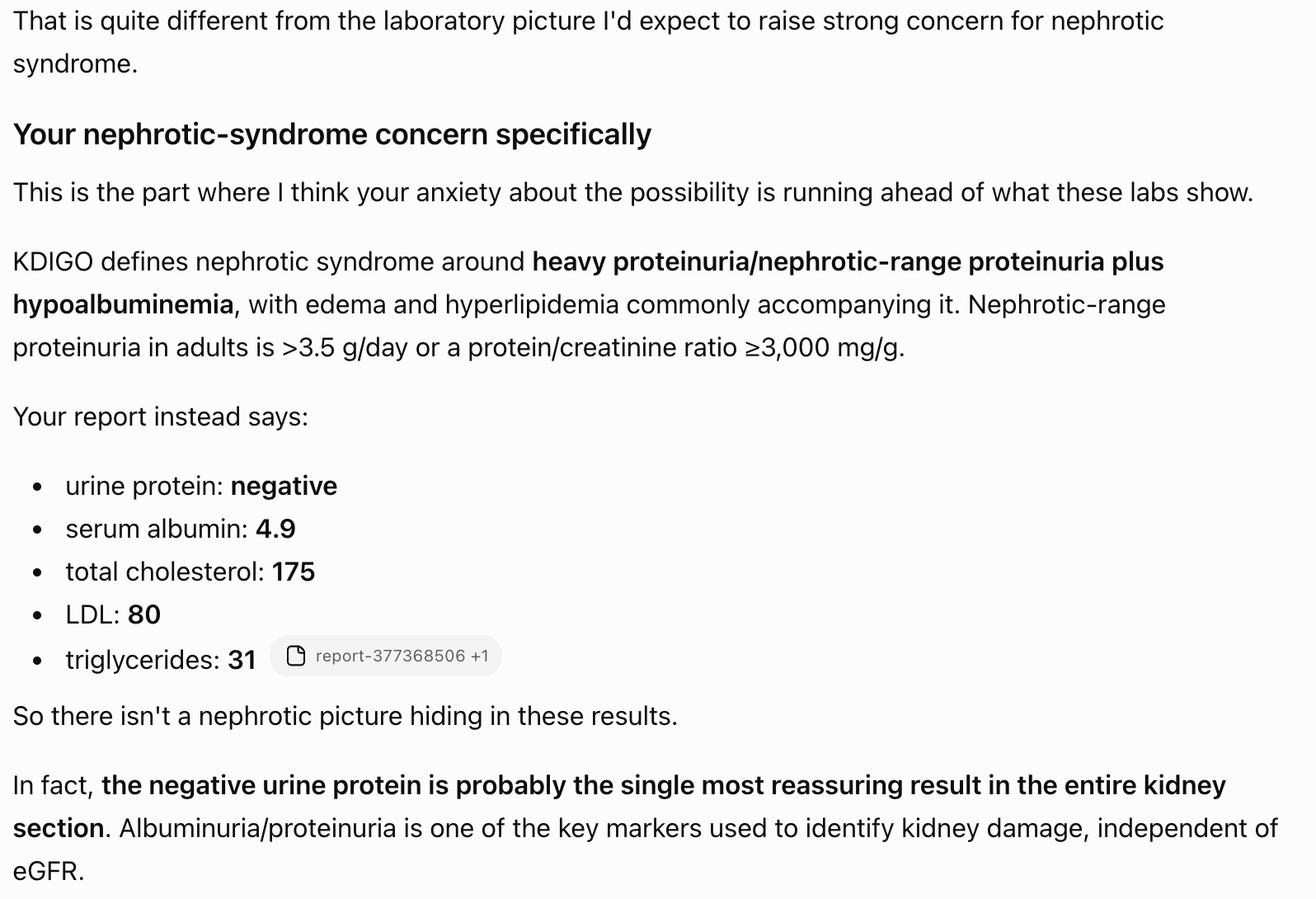
With this data, I could reasonably go back to my doctor and order more specific labs if I wanted to check on my kidneys. But I’ve known for a while that my kidneys are okay. This was more of a test to see how well it did at quelling anxiety.
It offers good structure - something most people lack - in creating a weekly plan — When I asked it to structure an exercise plan for me, I enjoyed the way it distributed my weekly workload, even if it wasn’t quite enough total work for my liking. There were timeframes I was recommended to train every day that were fairly reasonable, even when I hadn’t given it a realistic understanding of my daily schedule. This could very easily be a con if someone worked 50-60 hours a week and wanted to be as active as me, though that’s not many people.
