


Fitness is so much more than just showing up to a gym, sweating for an hour, and going home.
For a lot of people, it’s a complex math equation. It’s a daily conversation with oneself about how to choose foods, training times, block your schedule, stay an extra five minutes or what time to go to bed.
But you knew that, didn’t you?
It’s okay if you didn’t.
Many assume the journey is as simple as showing up, doing the work, and going home. Then clocking in the next day, rinsing and repeating, and stacking those days until results come.
There is a percentage of people who can get by that way. But it’s not a majority. The problem is that these people tend to be the loudest about how “easy” it is to get/stay in shape.
Trainers, coaches, ex-athletes, anyone who has locked in for an extended period of time and got where they wanted to be, and natural “hard-gainers” (think life-time lean people fit the archetype for the type of person who often (incorrectly) boil fitness down to “just train hard, eat right and sleep well.”
For the rest of the world population that aspires to be “fit” — whatever that means to them — there needs to be a certain alignment at a certain point in life, with a certain set of conditions that will actually make the change happens.
It’s just not always as simple as just deciding to change one day.
To give some context around the type of conditions I’m talking about, some examples:
A divorce or breakup
A doctor’s diagnosis (the bad kind)
An injury or major physical setback
A major transition in life (teenage to adulthood, young adulthood to middle age)
Losing a job/bombing an interview
Moving to a more active city
Having kids
Any other figurative kick-in-the-ass that prompts some serious reflection
In my personal practice, at least 80% of the hundreds and hundreds of people I’ve worked with were either on the cusp or in the midst of experiencing these things.
Seeing the level of motivation from someone in the above scenarios versus the average person just seeking guidance, structure or trying to maintain is staggering.
For a short time, the way they prioritize exercise is their main focus every day. A lot of the times it is fear-driven moreso than goal-driven.
Will I be able to live the same life if I can’t take care of myself?
Will anyone love me again?
Will I fit in this place, or will I be an outcast?
Fear is a good short term motivational tool, but not a long-term one.
Like anger, it is a type of fuel that is finite.
You can only revenge-lift your way to the body your ex wishes they had so much until it’s time to stop flexing on your ex.
When you’ve conquered the fear that started you on your journey, it doesn’t mean creating a NEW fear — it just means restructuring your mindset around the new reality.
You’re no longer a person who needs to exercise because you’re afraid of _____, you’re just a person who exercises.
Until you understand someone’s why for exercising, it’s never as simple as just suggesting “work harder.”
An identity change needs to be the main catalyst, and for the habit to be sustained.
Why This Matters
This seems to be where a lot of people in the fitness industry make a sales pitch.
Or it’s where a friendly suggestion from a colleague might come in: “Try this class! Meet my trainer! Sign up for _____”
They’re all benign and even helpful suggestions.
For some people, it can be the right place and right time to jump into those things.
But the timing of the universe doesn’t miss.
Still for some others, the timing and the commitment won’t be there, and I can say I’ve seen it first hand. Someone might feel like the path forward would be one of those things:
Start the low-carb diet and tracking app
Race the Ironman
Go to the Pilates class
Embark on the “75 Hard” with your friend
But two or three months passes and it feels out of alignment.
It’s a drag to maintain the schedule. You keep canceling on the trainer. The race or the event doesn’t excite you. The classes feel stale and the instructor is a tool.
That’s because the raw truth about your individual fitness journey is this: The journey fully starts when you are dead-sick of dealing with your own bullshit.
This doesn’t necessarily mean hitting rock bottom or experiencing one of the life-changing events I mentioned above either (although those things do happen simultaneously, often).
It just means you hit a point where you’re tired of spinning the same wheels. A point where you realize the next iteration of whatever you’re doing is going to produce the same lackluster result as this one.
It’s a point where you reckon with insanity — the same repeated effort with no changes — and choose sanity.
And that watershed moment isn’t always brought about by making the change you thought you needed to make.
In other words, most of the 80% I met (and still work with) hit that point BEFORE meeting me. I was a vehicle for helping them get to where they wanted to be, but not the main driver.
What might surprise you is this: I’ve also known clients and former clients to STOP or pull back training with me and find their real breakthrough.
They might’ve thought a coach would be the thing to whip them into shape, when really it was just getting up earlier and a coach was never the best fit for them.
I’ve never been the one to tell someone they need to make a major change. It’s a process that, in my opinion, needs to come about naturally.
I’ve seen people on the other side of their limiting beliefs, and I’ve also seen people still stuck inside them. The people I’ve worked with who were still stuck inside them usually found their unlock after they’ve decided to stop working with me.
This Instagram story from my brother Mylique (@plantabolic on Instagram) sums it up perfectly.
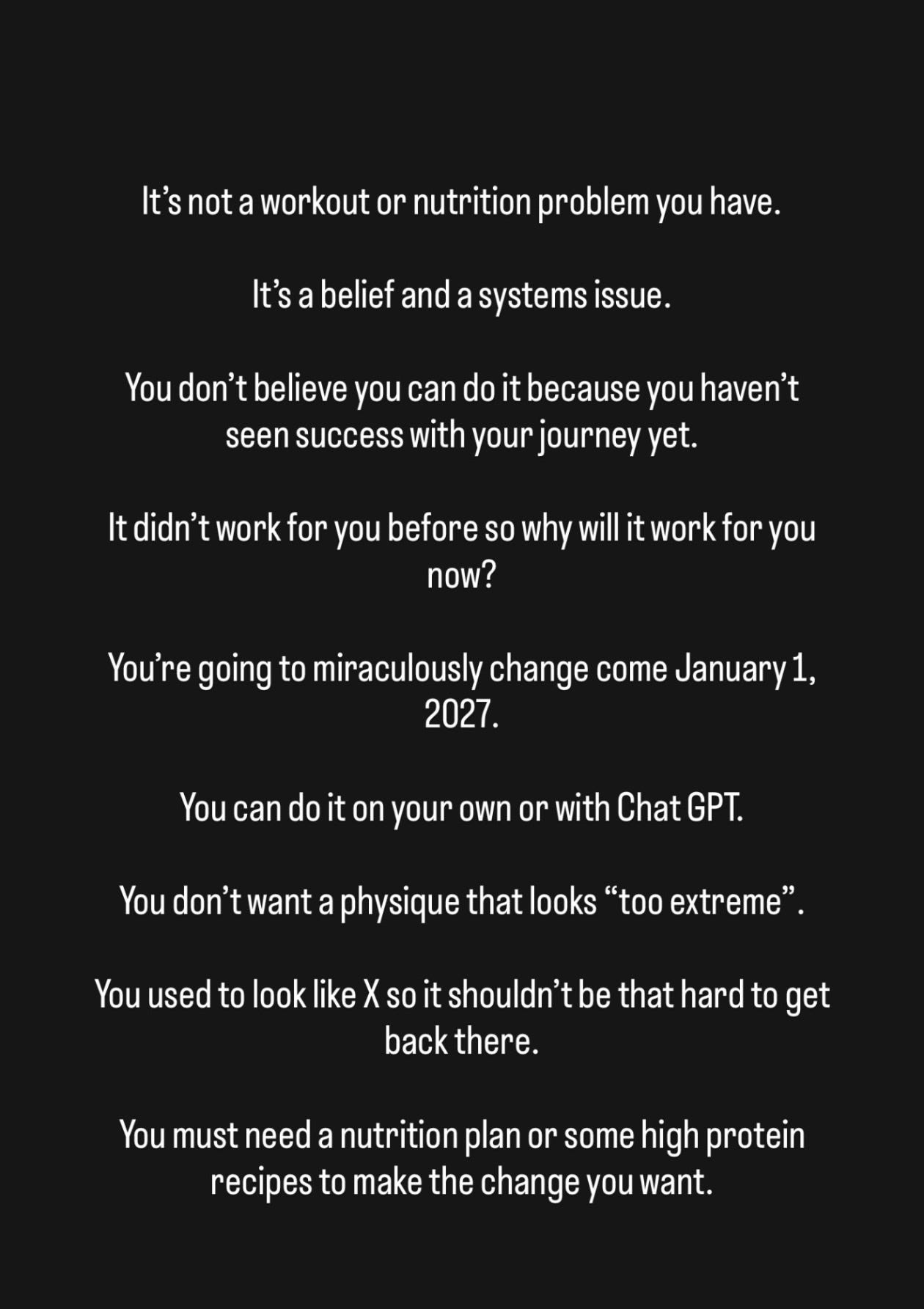
Not having the confidence to the decision to change your current situation isn’t terribly uncommon. Many get caught up in trying to find the perfect fix with their issues.
Brilliant.
The feeling of messing up what you thought was supposed to be the “fix” can be deflating. It’s better to keep pace with small, marginal improvements than try to get everything right at once.
Through that process of marginal improvements is where you find out how badly you want what you think you’re after, as Mylique explains below:
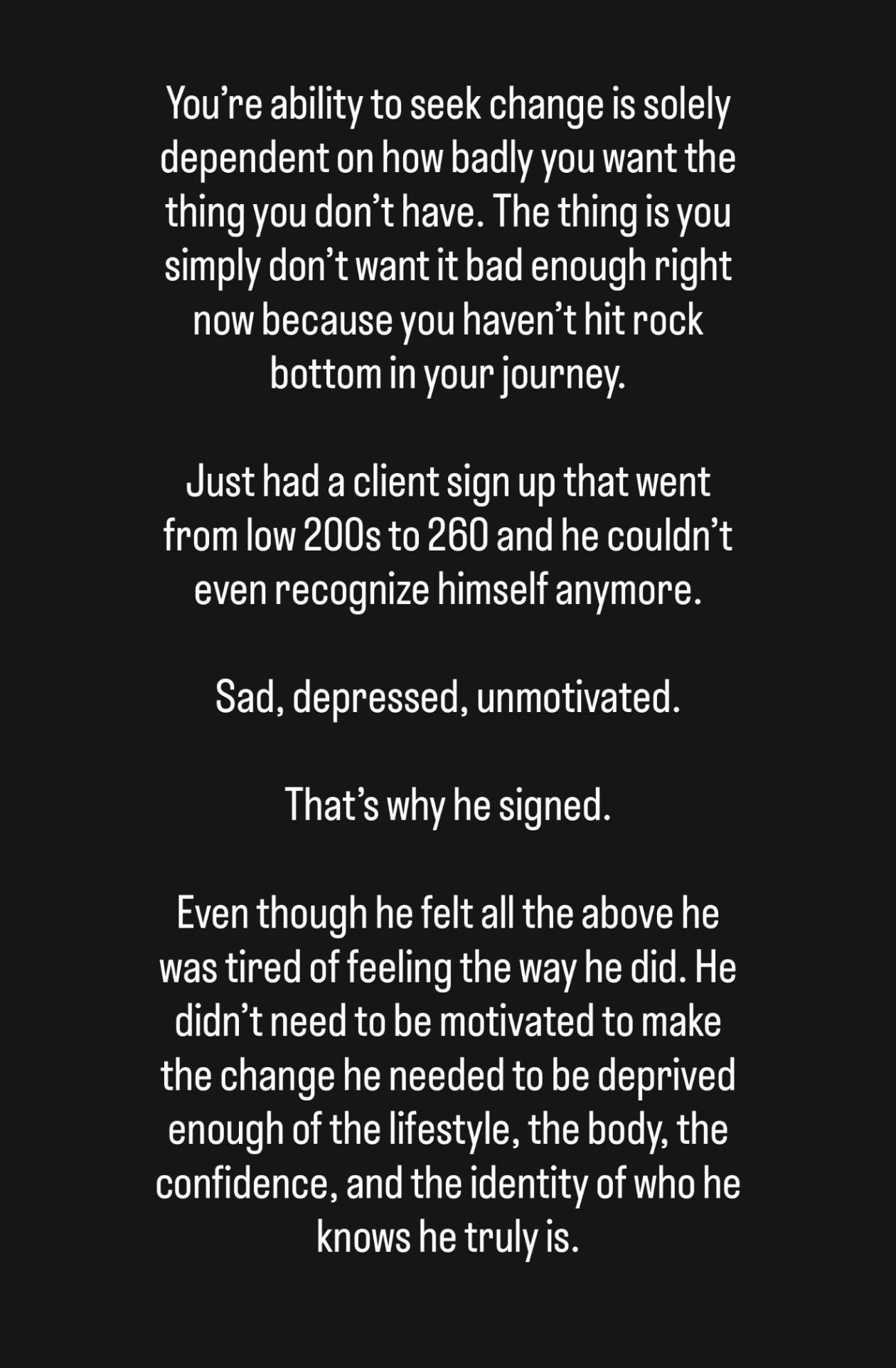
It’s the TIREDNESS of dealing with the emotions that lightly knock at your door every day until you decide it’s time to move out of the house completely.
That’s why I’m making a case AGAINST my own industry here — the personal training industry — in some respects.
Trainers can be great vehicles for change.
But they aren’t for everyone. They MAY or MAY NOT be the thing that helps you get fed up with your own BS.
In my opinion, it might not always be the trainer’s job to have that hard conversation with someone. It needs to come from within oneself.
(Props, however, to the trainers who can effectively deliver those pep talks).
So, the question you need to ask about your fitness, wherever you’re at, is this:
Are you telling yourself a story about where you’re at that isn’t objectively true?
Is there something self-limiting about the way you’re going about your routine that’s holding you back?
Or are you fabricating something about your health that isn’t reflected in how you look, feel, or carry yourself?
If so, it might NOT be a trainer’s entire responsibility to get you there. It might be a therapist or life coach’s.
It might be your own.
But the biggest changes happen when real reflection and identity change comes about, and like most things in life, those are brought about by a wide range of experiences, trial and error, and even loss.
The route you choose to go from there — self-motivated, coach-client relationship, or group — is totally your call.
But you have to be okay with not getting it right on the first try.
Happy suffering, my friends.