“Everyone has a plan until they get punched in the mouth.” - Mike Tyson
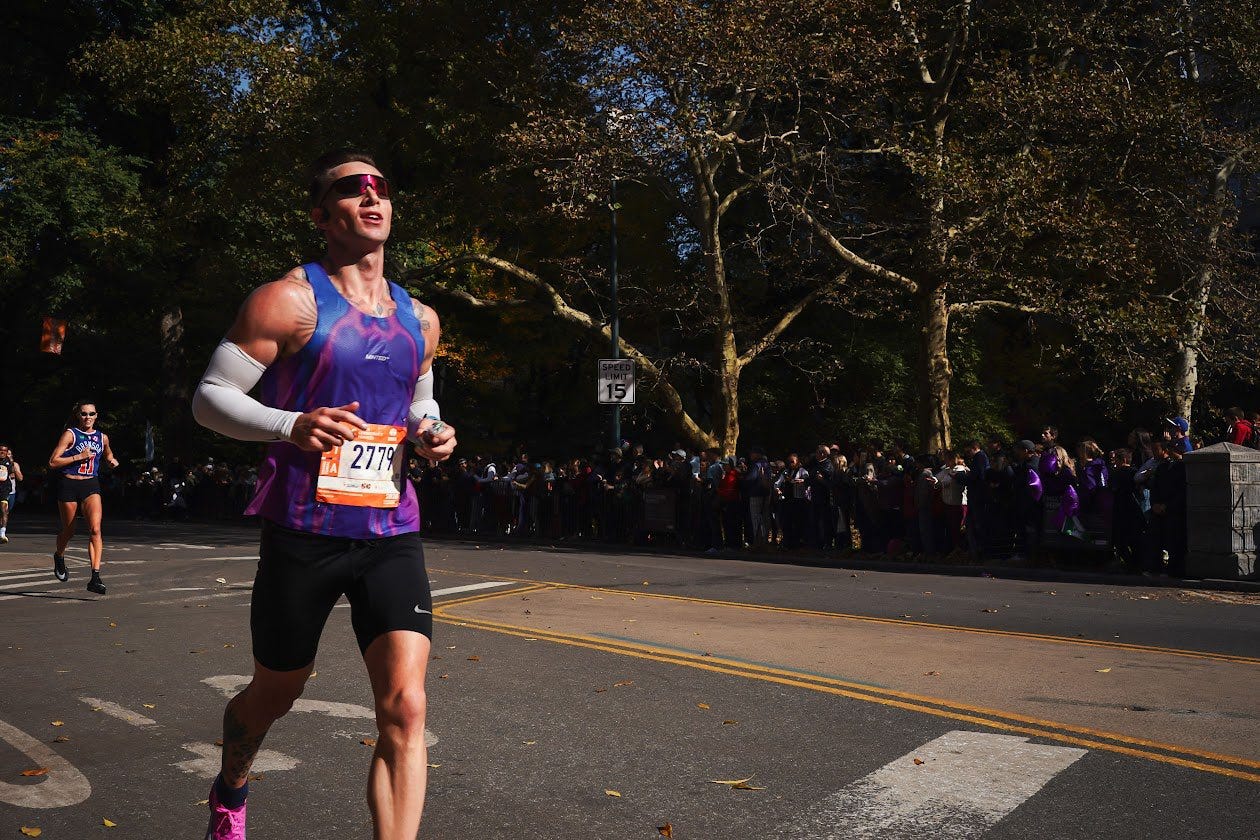
I was thinking about this quote in the lead-up and even during my race on Sunday, the 50th anniversary of the five-borough New York City Marathon.
Why?
Because I got punched in the mouth (multiple times) in last year’s race.
For me, it was absolutely necessary.
I entered last year with not nearly enough training, thinking I could run a sub-3-hour race in my second-ever marathon while being a) heinously under-fueled, b) cramping as a result of A, and c) focused on a Hyrox race I had 3 weeks later (which went awfully).
But this year’s punch in the mouth never came.
This year, I had my (figurative) mouthguard in, parried the punches, and swiveled out of the way to deliver a haymaker.
There are many, many takeaways from the race and the training.
I’ll try to do justice to all of them in this article, the likes of which will also apply to anyone trying to do anything hard.
Running this race gave me a level of confidence about myself I haven’t felt in a long, long time, and I think it’s important to share what worked for me both physically and mentally if my readers truly want to be High-Performance individuals.
Some of the Most Meaningful Work You’ll Do Happens When No One is Watching
There are many “isms” around achieving great things:
“Don’t worry about what others think,” “You only have one life,” “You’re only as effective as the five people closest to you,” yadda yadda yadda.
One that I was reminded of when I spent the better half of my high school career laser-focused on getting a college basketball scholarship:
The work you do when no one is looking is what moves the needle forward.
In a small high school with 600 students, having eyes on me felt crucial.
It was hard, maybe even painful, not to have a flashy highlight during a varsity basketball game.
It was demoralizing to see my teammates get more pats on the back when I was just coming off the bench for a few minutes.
That was when I started spending longer hours at the YMCA on weeknights and weekends. In the later hours of the day, when most of the people who played pick-up went home, I’d stay to shoot around for another hour or two.
Practicing the shots I’d shoot in-game.
Imagining a defender whizzing by me, pump-faking and shooting it.
Even creating scenarios where I had to shoot time-expiring buzzer beaters.
Those weren’t always things I got the opportunities to do in a game. But the more time I spent in the YMCA before a staff member kicked me out, the more those opportunities came. And they started to look like how I practiced them in the empty gym.
Where no one but me saw the shots go swish.
The same thing has rung true for my current focuses in sport, in my professional life, and in my personal life.
The most effective training runs were the boring, long ones I did by myself, with nothing but an audiobook playing and no one seeing my real-time pace except me.
The best newsletters — hopefully like this one — are the ones I sit down, jot down ideas for in my notes app, and Pomodoro my way through and proofread before blasting them out.
The best gifts I’ve given to my wife or surprise parties I’ve thrown for my friends have come from the little moments where I browsed our shared Amazon account (lol) or taken a mental note of a friend saying “I really want ____” and bookmarking it for a special occasion.
No one will see most of the work that goes into a really special moment.
In today’s world, where everything needs to be broadcast, LEARN to be OKAY with not showcasing the hours of work that it will take for something to be as close to perfect as you can get it.
Developing this muscle is also developing a deeper relationship with yourself.
As an introvert with extrovert tendencies, I’ve always found that it can be an INCREDIBLY useful skill to learn to be alone and be okay with it — sitting with your thoughts, thinking up new ideas, et cetera.
Being able to enjoy your aloneness allows you to appreciate the work you do alone more and amplify the work you do in front of others.


Getting Punched In The Mouth Is Necessary For Growth
I spoke about this in my previous newsletter last week.
We as humans are starting to get too comfortable with searching for, and even being outright handed, the easy way out.
You need to fight the urge to take the easy way out in more scenarios than you think.
Doing hard things, things that require your time, energy, attention, and even money, is a skill that pays dividends in ALL areas of life.
Without 2025’s breakdown at Mile 18, I don’t have a near-perfect race in 2026.
But I also don’t have a near-perfect race if I don’t sign up for the marathon.
This year’s race was a deliberate choice to risk getting punched in the mouth again.
If you’re unwilling to take that risk because you’re too scared to fail…
Then when are you ever going to do anything worth bragging about?
You need to be okay with (figuratively, of course) getting punched in the mouth (or eating sh*t, as I called it in last week’s newsletter).
No one I know and look up to has done anything of note without first falling flat on their face and learning from that mistake. Sometimes, those people even weathered multiple mouth-punches before they got to where they want to be.
Suffering is essential to the human experience, and we need to stop acting like that’s only something Buddhists should believe. It is part of a range of feelings we are PRIVILEGED to feel.
Some miles this past Sunday hurt a bit. That was the point.
The experience of having been punched in the mouth gives you perspective. It reminds you you’re not as high-and-mighty as you think you might be.
It tells you there’s always someone (or something) bigger, better, stronger, or faster in that moment.
But it also challenges you to get back up.
It challenges you to respond.
Not to lie there and accept defeat. And if you’re able to get back up, your attitude from there on out determines whether the next punch from life lands square in your jaw again, or whiffs and you punch back.
And most importantly, it changes your idea of what “hard” is. What was once difficult can seem like a cakewalk after you’ve made hard your new moderate, or even easy.
The Human Body is a Remarkably Capable Organism
Do we as humans have limits? My answer would be “maybe,” depending on what parameters we’re talking about.
If you told me even 2 years ago that I would run the marathon the way I did this past Sunday, I would have had a hard time fathoming it.
But the body—when fueled by a relentless idea formed in the mind —is capable of some absolutely wild stuff.

Deciding you want to go all in on some sort of physical activity or challenge can have tremendous downstream effects on how your physiology responds.
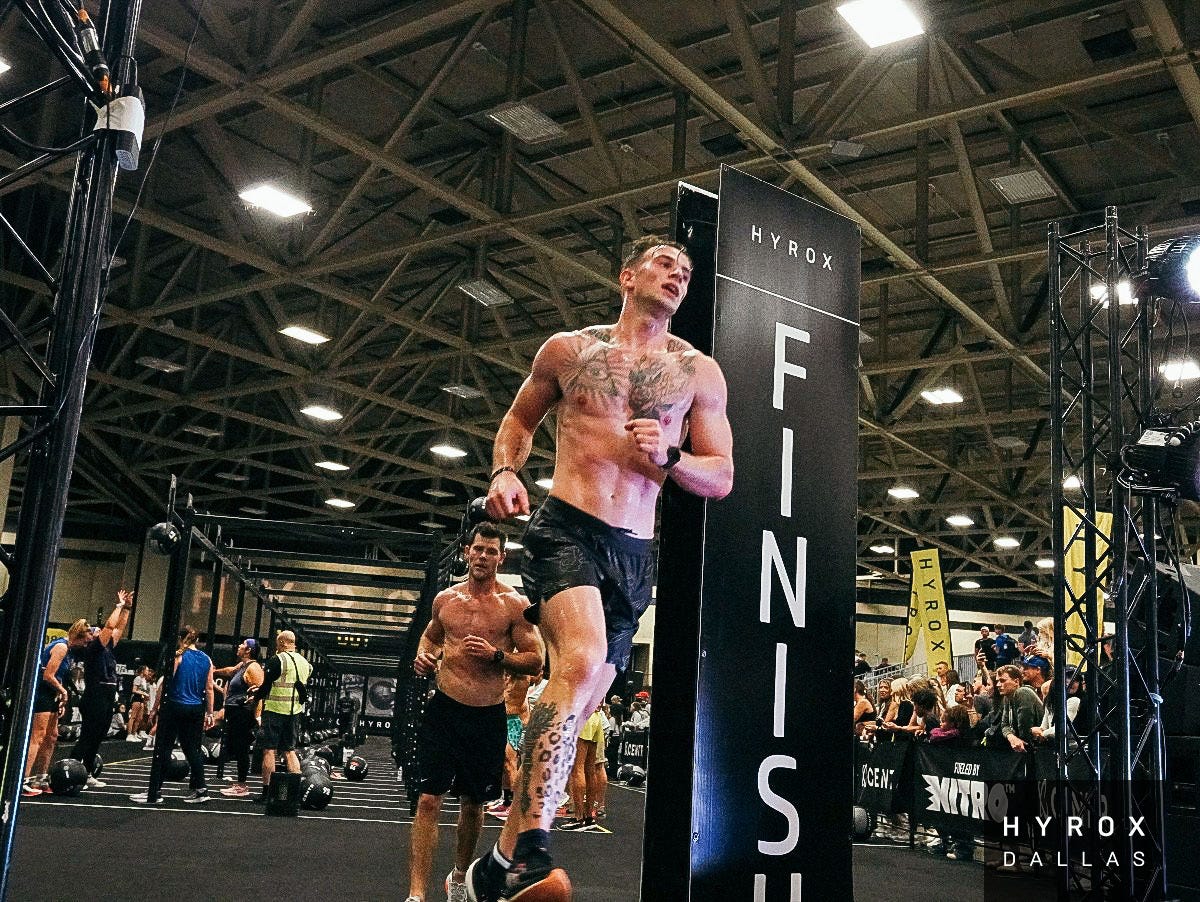
I knew after not having the best Hyrox performance a month ago in Boston that I wanted to fully dedicate my time to redeeming myself with a stellar marathon performance.*
*It is a bit anomalous to do Hyrox and marathons in the same season. I am not necessarily someone everyone can model their training after, but I have seen similarly impressive athletic turnarounds across many different sports.
I gave myself 4 weeks to push my body and then supercompensate for the New York City Marathon.
I had already developed a very strong engine this past summer, training in the heat, being diligent with running at incline (hills pay the bills), and fueling and hydrating adequately before, during, and after exercise.
I knew it would take an incredible amount of willpower — combined with race-day adrenaline — to hold the pace I was aspiring to this past Sunday.
So in my training, I did what I did back in high school at the YMCA.
I went to the course in my backyard in Queens.
I ran the Pulaski and Queensboro bridges back-to-back ad nauseam.
I remembered my legs and how heavy they felt in 2025. And I did everything in my power in these last few training runs to imagine myself NOT hurting at those points in the race, but instead being EXCITED and pushing harder.
It took 3 or 4 training runs running that route, the last 13 miles of the marathon, to develop a familiarity with the course in my mind that my body would remember on November 1st.
And even with the conditions being slightly different (a little more fatigue, a LOT more people cheering), my body did what it had to do in that moment.
This isn’t to say you can just will your body into doing whatever crazy activity you want it to do.
But you absolutely CAN use your mind and visualization techniques COMBINED with smart training and proper body awareness to put yourself in a flow state that makes a more grandiose physical effort feel less pressurized.
And the body, nervous system, and muscles may just all follow suit.
Training Does NOT Need To Be Perfect. You Just Need to “Win” your Workouts.