


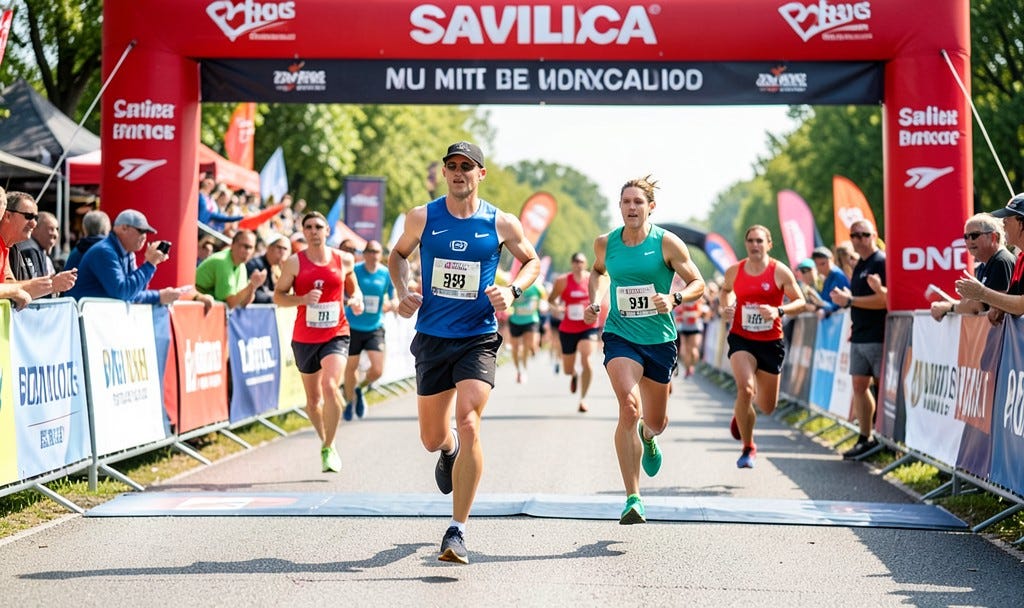
Lots of news lately around running.
The Chicago Marathon was this past weekend, and there were some exciting headlines coming out of it. Most notably, Vin Mauri, the treadmill extraordinaire who debuted in the Glass City Marathon in Toledo at 2:05:54, ran a 2:06:46.
Fellow American Clayton Young eventually surpassed him when he stopped at the 20-mile mark to stretch, but he’s become famous for nonchalantly jumping onto the scene while running 70 miles per week on the treadmill at Planet Fitness.
You read that right.
Along with breaking the American 30k record within the race and almost breaking Conner Mantz’ American Marathon record, he’s shown that the basics can work extremely well, and a little bit of confidence/the right mindset can go a long way.
On the Women’s side, Emma Grace Hurley, the current American 8k record holder, set the record for a Women’s Debut Marathon, running her first ever in 2:20.
Fun fact: I’ve followed her on Strava ever since she and I raced the Cow Harbor 10k together on Long Island in 2024. And when I say “together,” I mean she finished in 32 minutes, 11 minutes ahead of me, and had no idea who I was (and still doesn’t).
Between the Chicago buzz and a botched Boston trip for a Hyrox performance I’m not proud of (but one of my clients PR’d spectacularly in), I started to dwell on something:
I love racing.
More than I thought I ever would. And the crazy part? I feel late to the party. It got me thinking…
Why do we (humans) race?
What got into us, both now and back then, that caused us to lace up our shoes and compete for medals, podiums, and gear?
We can go back all the way to 776 BC to look at the first Olympic Race, the Stadion, which was a 192-meter sprint held by the ancient Greeks. It’s hard to know how many other racing events originated from this shorter-distance race, but this is what we have records of.
If we jump forward a few hundred years, we learn about Pheidippides’ 25-ish-mile run from Marathon, Greece, to Athens to announce the Greek victory over the Persians in the Battle of Marathon.
Hundreds and hundreds of years later, in 1896, back in Athens, the first modern Olympic Games paid homage to Pheidippides, hosting a competitive marathon run.
In 1897, the Boston Marathon was born.
For the past 100+ years, smaller races — 5 kilometers, 10 kilometers, half marathons, and 10-milers- have emerged as a way to welcome everyone to run-racing. These races take all shapes and sizes — competitive, cash-prize entries and simple turkey trots every Thanksgiving.
And in the past 20 or so years, ultra-marathon running — which encompasses any distance beyond a traditional 26.2 — has gained popularity as well.
This past weekend saw a small batch of highly dedicated trail runners and ultra-marathoners head out to Moab, UT, for Moab240, a 243-mile race through the desert of Utah. My good friend Alex was one of those runners.
Sadly, the race was canceled by the race directors due to Tropical Storm Rachel flooding the course and making certain sections of the trail unnavigable and a hazard to the runners.
Think about that for a second, though.
We’ve come from a few guys sprinting in a coliseum and one guy running (literally, for his life) 25 miles to now willingly signing up for races that are anywhere from 50 meters to 250 miles.
How did this happen? And why do humans love to race now more than ever?
For the sake of accuracy, I can speak mainly to popularity in the United States in today’s post. What is almost certain is that other less-developed countries, namely those in Africa, have had runners for much longer than the U.S. has.
The reason Kenyans and Ethiopians are at the front of every major marathon is that their people have been running recreationally, competitively, and routinely for much longer than we have (and will likely continue to do so now because of that reputation).
It wasn’t until Frank Shorter became the first Olympic Marathon Gold Medalist in 1972 that a larger share of Americans started to take a real interest in distance running and racing.
Along with that, the formation of Title IX that year also allowed more women into sports (shoutout to RunTheDay.com for these citations and the below graphic), which catapulted running popularity exponentially.
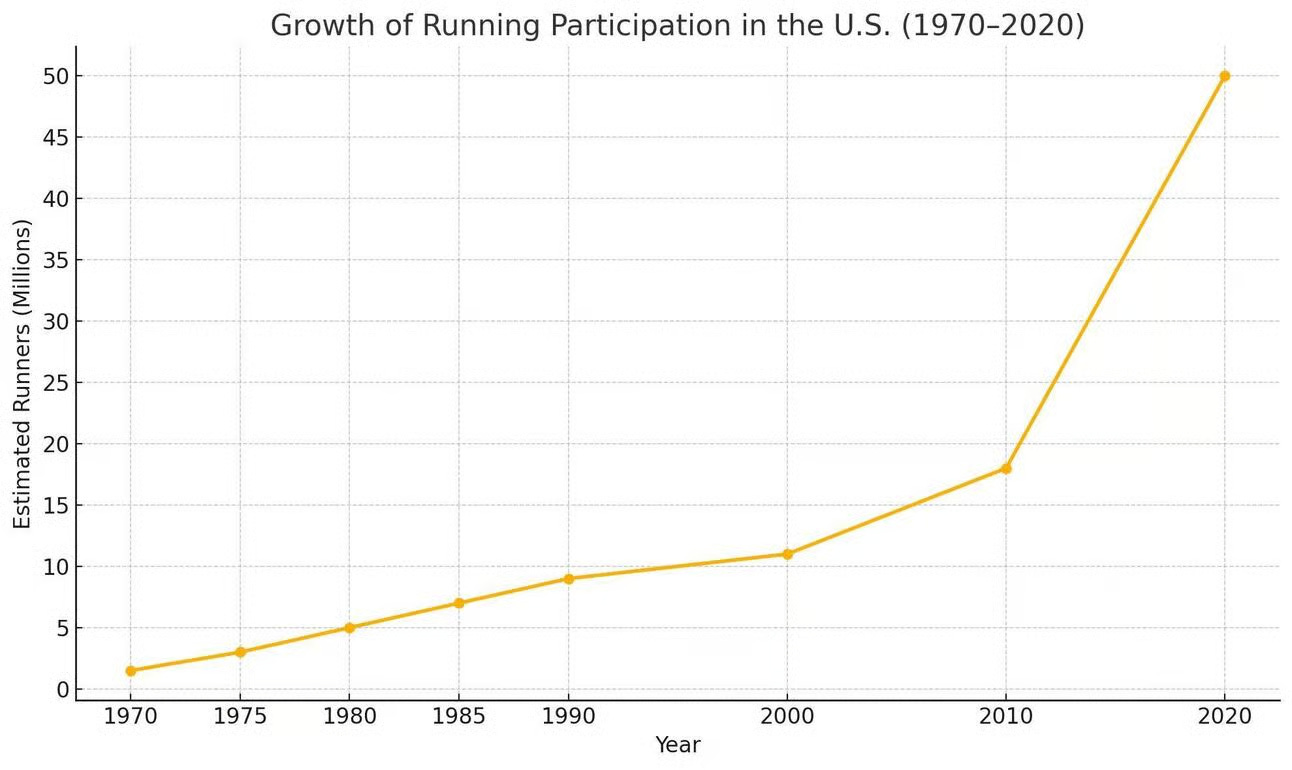
As the graph shows, the next few decades after 1972* would see exponential increases in popularity; millions more became drawn to running as philanthropy infused running for a cause into the mix, and technology like shoes (shoutout to Bill Bowerman), GPS, and smartwatches enabled more data and performance.
*Honorable mention - I am currently reading The Running Ground by Nicholas Thompson, CEO of The Atlantic, and 2:29 Marathoner. Thompson’s running prowess dates back to pre-1970, when he first saw Bobbi Gibb, the unofficial (or official, depending on how you look at it) first woman to run the Boston Marathon in 1966. Gibb famously masqueraded as a man sneaking onto the course near the start line, and finished ahead of many of the most talented men that day. The ethics of participation were debated intensely afterwards, but it’s very possible she had a lasting impact on the decision to bring women into competitive running with her stellar performance. Mind you, this was before super shoes existed — she ran almost the entire race in some worn men’s shoes (and some of it BAREFOOT) that she hadn’t even broken in.
When we jump to the 2000s, social media likely only helped running grow even more.
Once people could share personal bests, first-time runs, weight-loss journeys sparked by running, and dabble in new routes and paths across the world, the appeal could only grow.
This likely stoked runners' competitive drive as well. Social media, for all its boons, can be a terrible source of comparison, which can become toxic if you don’t take periodic breaks.
That said, competition is good for any sport. The dawn of shareable content no doubt made the line on the above graph go parabolic.
So, what inside of us makes us want to keep doing this crazy thing? Why would we willingly skyrocket our heart rate for 20 minutes to an hour multiple times a week, month, year just for a medal/to say we beat someone in our age group?
On a biological level, racing floods the body with dopamine and serotonin.
Dopamine, being the anticipatory hormone, brings on feelings of excitement and joy for the opportunity to compete. Whether someone is a former athlete or is just maintaining their fitness late into their life, running a race offers a chance for any participant to feel like an athlete again and chase the same feelings that literally make us young.
Serotonin and oxytocin, which come after the race, generally elicit joy, reduce stress, and ease the brain into a state of meditative gratitude and happiness. Couple these hormones with the fact that racing can produce a healthy cortisol spike-drop cycle, boost overall fitness and cardiorespiratory function, and promote better sleep (obviously), and you’ve got one of the most potent fitness cocktails ever.
Also, it doesn’t just feel good to win things — because in today’s day and age of running, which I’ll get to in a second, it’s far too saturated to come first in anything — but it feels good to come close to winning.
Competitive psychology will tell us that some who feel the pressure to perform enjoy not only the thrill of winning, but the competitive dopaminergic steps it takes to get there, like meal and nutrient timing, the split seconds it’ll take to hit your goal time, and managing fatigue via the mental conversation you have with yourself.
Not everyone enjoys these things outright, but people can develop a passion for seeking them out with more racing.
Now, chronologically, how did we get here?
Going back to our timeline of running popularity, we left off in the 2000’s, just after social media boomed and runners started to gravitate more toward the sport in a communal kind of way.
Let’s jump to 2020 - the COVID-19 Pandemic.
I don’t have to recap much.
The world was shut down. And so were gyms. Most people took fitness into their own hands. Runners who were already running were mostly unaffected.
But those who usually relied on the routine of gym equipment and a workout split went a little nuts. Many needed some other form of fitness to bottle their exercise energy into. And a large, undetermined share of lifetime lifters took up running (myself included).
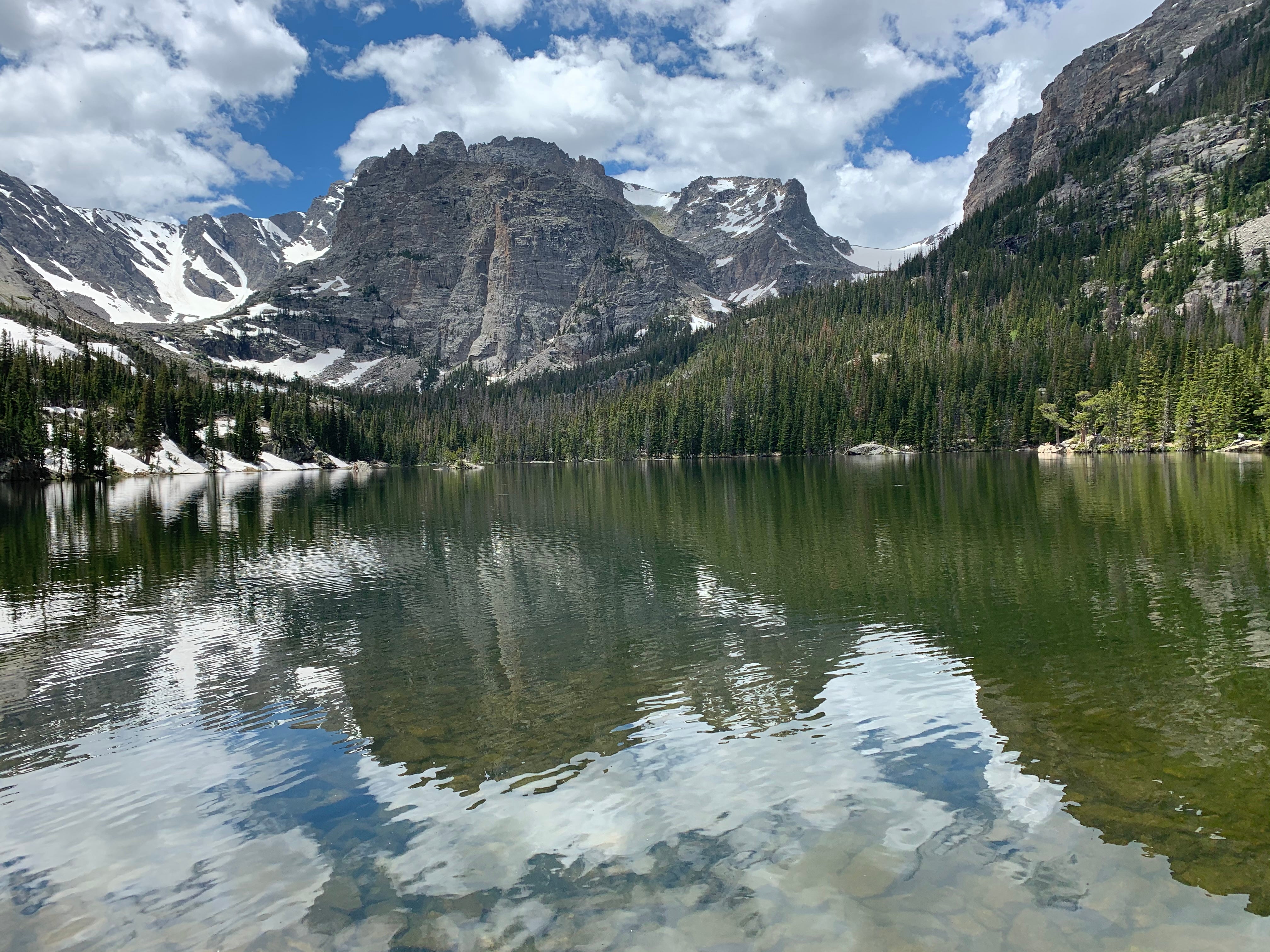
Well, technically I started hiking more since I had the luxury of escaping to Colorado, but I definitely had more time on my feet during COVID than I did with the weights:
Anyway, those people quickly found a new obsession with jogging, running, and racing. Many of them likely still go to the gym now that the world is back to normal and weren’t full converts, but I’d wager running is more of a cardio staple in most people’s routines now because of COVID than ever before.
It drove many more millions to sign up for the first race, because let’s be honest;
Running recreationally without putting your fitness to the test can be a bit dull sometimes. I’ve never known anyone who runs without signing up for a race, channeling the adrenaline that comes with toeing a starting line, and seeing what their legs and lungs are really made of.*
*If you find one of these people, please refer them to me for research.
What running from 2020-2026 has also become is a new wave of challenges for achievers and over-achievers alike.
Not everyone who starts running keeps going. Not everyone who starts starts hot.
It can take years for running to become enjoyable for some, and even longer for others to get quick enough to even be competitive in a race or their age group.
For many who enjoy trying to maximize their potential, this can become a lifelong game or challenge.
Longevity studies show that people who aspire to more things, keep themselves busy with routines, and consistently challenge their brain and mind muscles with these types of endeavors fare better neurologically over the long term.
Also, epidemiologically, it’s just badass to be fast.
I always tell my clients that no one is out-strengthening the zombie apocalypse (half-joking). We gotta be able to run.
What about the future?
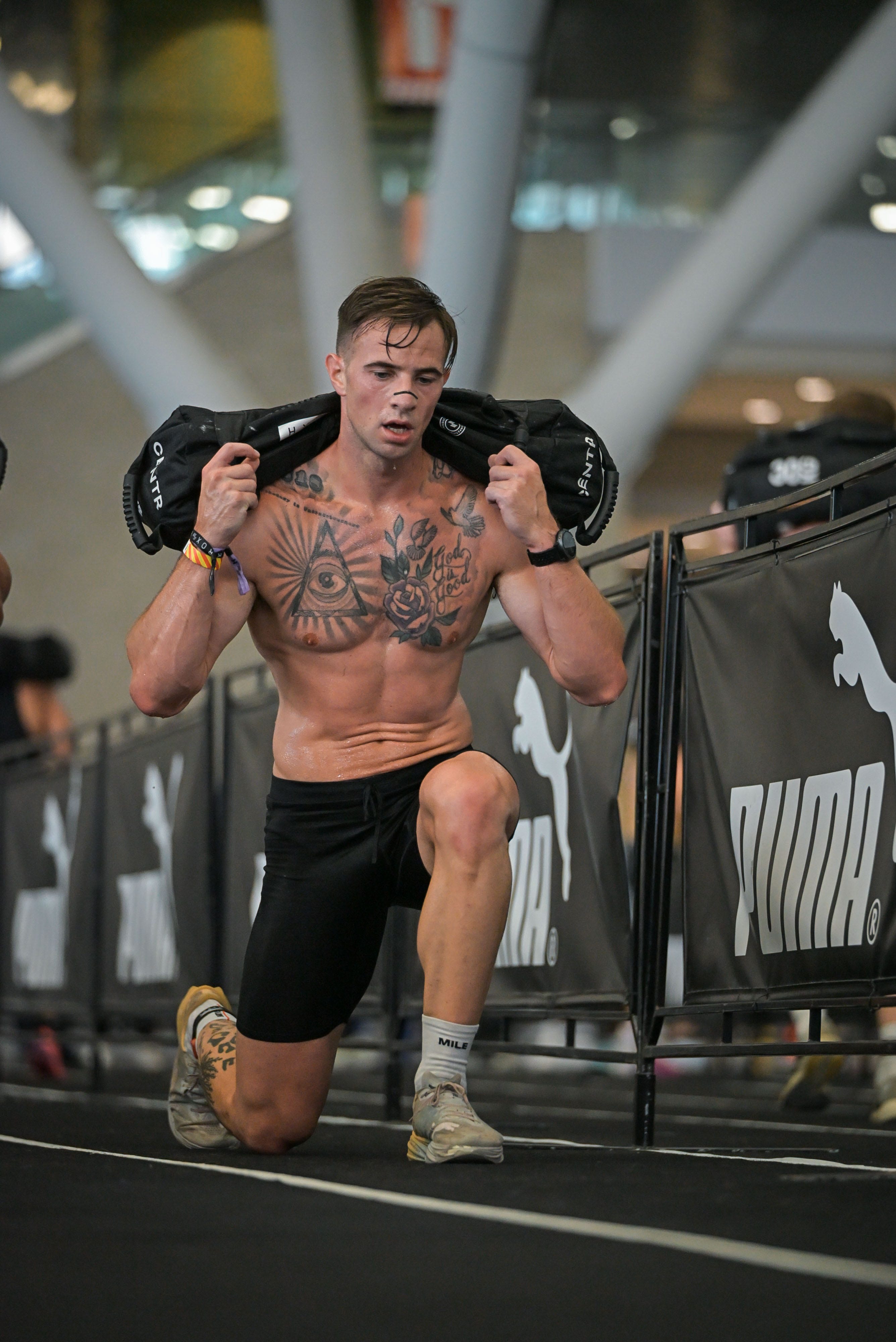
My operating theory about the race styles that have dovetailed out of traditional running — Triathlons, Ironmans, Hyrox, Ultras, et cetera — is that normal running is still not enough for some.
Regular running is now so accessible to everyone that some people need new domains to carve out their legacies in their “Hero’s Journeys.”
Anyone who wants to feel like someone wants to be a high-achiever in their individual domain. So switching to one of these sub-divisions of running, so to speak, is a great way to become notable.
Again, taking it back to Darwinian theory, most people want to be accepted. Acceptance has historically come from competence and success in a given field, which leads to recognition, praise, and so on.
If we can use a sport like running or racing to carve out a name for ourselves (or even a second name, since many competitive athletes are high achievers elsewhere), why wouldn’t we?
I’ll never quite understand why people make a mockery of running or racing, or why there’s infighting amongst the subdivisions of it, as if one is better than the other (spoiler: none are).
What feels incredibly promising for me is the idea that everyone has a race.
Metaphorically, figuratively, literally.
People have an incredible amount of options to compete in a variety of races where they can feel seen, accepted, praised, and lauded.
They have even more opportunities to use those races as races against themselves; that is, to be able to improve upon their previous time or performance.
And we’re all in a race against time.
Time, unfortunately, waits for no one. But we can stave it off by racing. Because in racing, whether it's five minutes or five hours, time disappears in the traditional sense.
All that matters during a race is the conversation you’re having with yourself, the course, and enjoying it. Oh, and winning, if you can.
And “winning” looks different for everyone. But that laser focus on those facets of a race slows time down in a way. It makes you forget there is a clock ticking on the day.
Forget that there is a clock ticking on our lives. And yes, it might even slow that clock down by adding some more time back to our lives.
While (I hope) no one thinks about racing solely for the benefit of living longer, I think racing exists just as any advancement in society does:
To help us find our potential. To test us in a domain that can, at times, be very uncomfortable and foreign. And, for just a moment, make us feel like we’re an Ancient Greek at the Stadion.
Happy Thursday, folks.